Second Quarter 2026 Commentary & Outlook
Dear Clients,
I hope this letter finds you well. It was an eventful second quarter, in and outside of capital markets. This past June, I turned 30 and I got engaged. People I know have jokingly asked whether I feel different, and until this year my answer was always no. But at 30, I do feel a difference, and some of it comes from what I have observed since my early twenties.
When I was in college, the entire conversation revolved around a handful of names, the FAANG stocks, Facebook, Amazon, Apple, Netflix, and Google, and the future felt more or less decided. My first real seat was at a venture capital fund of funds, right as cryptocurrency and blockchains went from curiosity to a full mania. Then the pandemic arrived.
I watched interest rates fall to almost nothing while all of us sat at home, and I saw what happens when people are stuck inside with cheap money to borrow, namely retail investors piling into highly leveraged bets on volatility. I watched global supply chains seize up, and then the long, uneven fight against the inflation that followed. I have seen geopolitical conflict bleed into markets, and I have seen it bring real hardship to people who did nothing to deserve it. I have watched some legendary companies make critical mistakes, and nimbler newcomers with a sharper product walk straight through the door those mistakes left open. And now I am watching artificial intelligence take hold, and a wave of capital spending that a lot of thoughtful people are calling the next industrial revolution.
What all of it tells me is that I have lived through some genuinely interesting times. I came up watching momentum feed on itself and I am watching it again in a wave of new funds and products built to ride whatever is already working, with money flowing ever faster toward what has already gone up. So here is my point, and it is a simple one. Yes, I have seen some things. That does not mean I know everything. While turning 30 has given me a greater sense of confidence, it has also underscored the importance of not counting out the unexpected.
Which brings me to the second quarter. It was a strange one to sit through. The headlines swung almost daily, war and then talk of peace, oil spiking and then falling, a change in leadership at the Federal Reserve, inflation that would not cooperate.
Cutting through the noise, equities rebounded from the first quarter’s tumble and then kept climbing, finishing the quarter near record highs. On paper, that is a quarter worth celebrating. And yet a recovery that fast, arriving while the news was still this unsettled, is exactly the kind of thing that makes me want to look closer rather than cheer.
Market Performance Summary
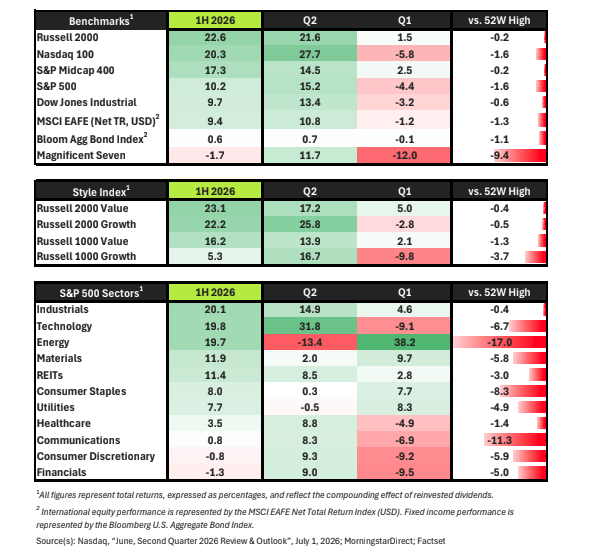
- The S&P 500 rebounded 15.2% in Q2, more than erasing the first quarter’s decline and finishing just 1.6% below its 52-week high.
- The Nasdaq 100 led the major benchmarks, up 27.7%. Notably, though, the Magnificent Seven trailed the broad market, gaining only 11.7%, less than the S&P 500 itself, so the rebound in technology ran wider than the familiar mega-cap names.
- The rally was broad rather than narrow. The Russell 2000 rose 21.6% and the S&P Midcap 400 gained 14.5%, so small and mid-sized companies took part fully rather than being left behind by the largest stocks.
- Developed international markets advanced but trailed domestic large caps, a reversal from Q1. The MSCI EAFE gained 10.8%, though it remains 1.3% below its 52-week high, as the easing of the Iran conflict and falling oil prices relieved pressure on energy-dependent European and Asian economies.
- Energy was the mirror image of last quarter. After leading every sector in Q1, it was the weakest sector by a wide margin in Q2, down 13.4% as oil retreated from its highs. Aside from a fractional dip in utilities, it was the only sector to decline, and it now sits 17.0% below its 52-week high, the widest gap of any sector.
- Growth reclaimed leadership over value in both size segments. Large cap growth rose 16.7% against 13.9% for large cap value, and small cap growth rose 25.8% against 17.2% for small cap value. Technology reflected the same swing, moving from one of the weakest sectors in Q1 to the strongest in Q2, up 31.8%.
- Bonds sat the quarter out. The Bloomberg Aggregate Bond Index was essentially flat at 0.7%, so the quarter’s gains came almost entirely from equities.
U.S. Economy: Q2 2026
Looking back at the first quarter of 2026, the final estimate for GDP (Gross Domestic Product) came in at 2.1% on an annualized basis, a rebound from the 0.5% pace of the fourth quarter of 2025. Because official growth figures arrive on a lag, the first quarter remains the most complete reading we have as we write, with the second quarter’s advance estimate due from the BEA (Bureau of Economic Analysis) on July 30.
Despite the welcome improvement, most of the gain came from a jump in government spending, which bounced back after the late-2025 federal shutdown, and from strong business investment, much of it tied to the buildout of artificial intelligence. The everyday consumer stayed comparatively quiet.
The second quarter’s own figures, which run a month behind, point the same way. Adjusted for inflation, consumer spending was roughly flat in April and rose just 0.3% in May, and measured against a year earlier, real spending growth has been fading, easing to about 2.1% in April from roughly 2.6% at the start of the year. Households are keeping it up partly by saving less, with the saving rate down at 3.0% in May, and part of that month’s income gain came from one-time federal farm relief rather than broad wage growth.
Inflation moved the wrong way. The CPI (Consumer Price Index) rose 4.2% in May from a year earlier, a three-year high, with energy responsible for more than 60% of that month’s increase. More reassuringly, the core reading, which sets aside food and energy, stayed just under 3% and housing costs cooled, a sign the jump was concentrated in fuel rather than spreading. Even so, much of today’s inflation comes from energy and tariffs, the kind of pressure interest rates cannot easily reach.
The largest change of the quarter came at the Federal Reserve itself. Jerome Powell’s term as chair ended in May, and Kevin Warsh was sworn in to replace him, with Powell staying on as a governor. The shift was more than a name. At Warsh’s first meeting in June, the FOMC (Federal Open Market Committee) left the federal funds rate unchanged at 3.50% to 3.75%, where it has stood since December, but it sharply shortened its public statement and pulled back from signaling where rates go next. The committee’s own projections, which had pointed to a cut earlier in the year, moved toward a possible increase instead, and Treasury yields climbed to multi-month highs as investors adjusted.
The Bottom Line
he economy enters the second half of the year in an odd position. Growth is present but uneven, inflation is stubborn for reasons largely beyond the Fed’s control, hiring is slowing, and the central bank is under new leadership that has chosen to say less about what lies ahead. And yet stocks finished the quarter near record highs. That gap, between how confident the market looks and how unsettled the ground beneath it feels, is the real story of the quarter. It is not a reason to retreat, but it is a reason to hold our standards firmly rather than follow whichever headline is loudest.
Looking Ahead: Q3 2026
Markets have treated the winding down of the conflict with Iran as a turning point, and oil has fallen well off its highs. We share the relief, but we would read it carefully. A framework to reopen the Strait of Hormuz was signed in mid-June, and yet tensions have persisted as talks toward a lasting deal have stalled. Iran has made it clear that it does not intend to surrender its leverage over the waterway easily. Ships are moving through again, but traffic has not returned to normal. An agreement on paper does not mean the conflict is over. Because of this, disruptions could continue in the form of costs for fuel, shipping, and maritime insurance with the latter two often falling on the consumer.
In an environment this noisy, the best move is often the one that feels too simple, and that is to do very little. We do not mean ignoring your plan. We mean not reacting to every swing in the news, not trying to guess the market’s next turn, and not mistaking motion for progress. The clearest lesson of the year is in plain sight: anyone who sold in fear of the first quarter missed the recovery that came right behind it. Zooming out nearly a century, the S&P 500 has finished higher in roughly three of every four individual years, and across every twenty-year period on record it has never once ended lower than it began. Past results are never a promise of future ones. But the pattern is hard to ignore, and it points in one direction: the longer you stay invested, the more time tends to work in your favor.
The next few weeks will bring second-quarter earnings, and after a rally this strong, the bar companies have to clear is unusually high, so we are watching whether the results justify the optimism already priced in, rather than reacting to any single headline.
Through a busy and often loud six months, the part of this work we value most has not changed, and that is the trust you place in us and the conversations we are fortunate to have with you. Thank you for it. We do not take it for granted.
If someone you care about is trying to make sense of this market without a clear plan or a second opinion they trust, we would welcome the chance to help. We treat every introduction with the same care we bring to your own family’s affairs, and we count it a privilege to be trusted with the people who matter to you.
Regards,
Alec Campbell | Vice President & Investment Advisor