
The Family Wealth Series, No. 03 · October 2026
How Beneficiary Designations Work, and Why the Will May Not Control Them
What the beneficiary form on a retirement account, life insurance policy, or bank account dictates, and what happens when a beneficiary dies first or no one is named.
By Alec Campbell, Vice President & Investment Advisor
I. What a Beneficiary Form Controls, and What the Will Does Not
A beneficiary designation form, or simply a beneficiary form, is a document the owner often completes when an account or insurance policy is opened. It names who receives the account, or the policy’s proceeds, when the owner dies. Many people fill one out early in life and never think of it as part of their estate plan, even though an account or policy with a named beneficiary usually passes straight to that person without going through probate. Probate is the court-supervised process for settling an estate, and it tends to be slower, more expensive, and public.
When families start thinking about who inherits what, the first thing that comes to mind is the will, and people tend to assume it has the final word. For an account with a beneficiary form on file, it doesn’t. The form is part of the owner’s agreement with the institution, so when the owner dies, the institution follows it. It doesn’t read the will, nor does it wait for it. When the two say the same thing, there is no problem. The risk is that they are often written years apart, and no one checks one against the other. Robert found this out when he sat down to help his mother, Heather, get her affairs in order.
Heather spent thirty years growing her father’s auto mechanic shop from two locations to six. Last spring, she sold her company to retire early. After years of building a nest egg, she wanted to make sure it would go where she intended. Her new will was simple. Everything would go to her husband, and after him, to Robert and his brother Michael equally. Robert read through the draft with Michael listening in on speakerphone, and it said exactly what the family expected.
The surprise came when their advisor set Heather’s account statements next to the draft. Most of the family business sale proceeds had gone into an account in Heather’s own name, opened decades ago. Next to her name were three letters, TOD. With Robert beside her, Heather called the brokerage to ask who it named. The answer was her sister, Iris. Her attorney had asked about her accounts, and Heather had listed them from memory. Neither she nor anybody else had looked at the beneficiary form since the day she signed it. If Heather died today, the largest thing she owned would go to her sister, and the will, however carefully drafted, would have no say over it.
The will says her husband, then the boys. The form says Iris. At her death, the form decides.
It is worth being clear about what a beneficiary form does not do. Naming Iris decades ago did not make her an owner. She has no rights to the account today, and she may not know she is named at all. Heather still controls every dollar in it, meaning she can spend it, invest it, or change the beneficiary by filling out a new form. A beneficiary form generally takes effect only at death.
We have seen this pattern before: a beneficiary form signed decades ago, never revisited, quietly dictates where the largest asset goes. Heather’s story involved just one account. Most families have several, and they don’t all pass the same way. Retirement accounts, life insurance policies, and bank and brokerage accounts with a payable on death (POD) or transfer on death (TOD) designation usually pass directly to the people named. What goes through the will is what remains in the original owner’s name alone, with no beneficiary left to receive it.
Beneficiary forms do not live in one place, and each institution keeps its own. On bank and brokerage statements, TOD or POD after the owner’s name means a designation exists, but finding the name behind it may take a login or a phone call. Retirement account and insurance statements usually won’t show one, so the only way to know is to ask. The table below shows where to look for each kind of account.
Where to Find the Beneficiary Form for Each Type of Account
| Asset | What it is called | Where to find it |
|---|---|---|
| 401(k), 403(b), and other employer plans | Beneficiary designation | The plan’s website or the company that runs it, including plans from former employers |
| Pension | Survivor benefit election | The pension plan administrator |
| IRA or Roth IRA | Beneficiary designation | The custodian’s website or a form on file |
| Life insurance | Beneficiary designation | Your policy records, or the insurance company |
| Annuity | Beneficiary designation | The insurance company that issued it |
| Checking, savings, CDs | Payable on death (POD) | Online banking, or ask the bank |
| Brokerage account | Transfer on death (TOD) | The account’s beneficiary page online, or ask the firm |
| Health savings account | Beneficiary designation | The HSA provider, not the employer |
| 529 college savings plan | Successor owner | The plan’s account settings. The “beneficiary” on a 529 is the student, not who inherits it |
| House or land | Transfer on death deed | County land records. Available only in some states |
Where families run into trouble
A divorce, a remarriage, or a death in the family can change who should receive an account. The beneficiary form does not change on its own, and a former spouse can remain the beneficiary.
II. When a Beneficiary Dies First, or No One Is Named
Planning assumes events will happen in a certain order, and life does not always cooperate. Suppose Heather never filled out a new beneficiary form, and the old one still named Iris. What would happen if Iris died before Heather? The answer depends on a second line on the form, one Heather left blank.
Primary and Contingent Beneficiaries
A primary beneficiary is first in line to receive the account or insurance proceeds. A contingent beneficiary is second in line and receives it if the primary has died, cannot inherit, or chooses not to inherit. Heather had named Iris as the primary beneficiary and no one as the contingent.
What Happens When There Is No Beneficiary
When a beneficiary dies before the owner and no contingent is named, the account usually follows the institution’s default rules, and the same is generally true when no beneficiary was ever named. For brokerage accounts, the law in most states sends the account to the owner’s estate, and bank accounts with a payable on death (POD) designation generally work the same way. With Iris gone and no contingent named, Heather’s brokerage account would go to her estate, through probate, and then follow her will’s instructions: her husband, then the boys.
On paper, Heather gets the result she wanted. In practice, it arrives late and at a cost. Probate can involve court filing fees, attorney fees, and executor compensation. It can also take months to settle, and sometimes years. Avoiding all of that is much of the reason to have a beneficiary form in the first place.
How Retirement Plan Rules and State Law Can Change the Outcome
Not every account follows the same default, even at the same firm. Some retirement plans and insurance policies have their own backup order written into their rules, such as a surviving spouse, then children, then the estate. If the account had been a retirement plan instead, its rules might have paid Heather’s husband first, without probate.
State law can also change the outcome. In some states, if certain relatives named as beneficiaries, such as siblings, die first and no contingent is named, the law may pass their share to their own children. Because Iris is Heather’s sister, in those states the account could go to Iris’s children instead of Heather’s estate.
The form named one person. With that person gone and no one else listed, the account follows rules Heather never chose.
III. How a Beneficiary Form Splits an Account, and What Per Stirpes Means
Suppose Heather fills out a new beneficiary form after all. After talking it through with her husband, who has his own retirement savings, she replaces Iris with Robert and Michael to receive half each, and lets her attorney know so the rest of her estate plan reflects it.
Splitting an Account Among Multiple Beneficiaries
Beneficiary forms generally let the owner name more than one person and decide how the account is divided among them. The percentages must add up to 100%, and on many forms, if they’re left blank, the account is split equally. The plan feels settled until Robert, who has two young children, asks a question that gives everyone pause: what happens to his half if he dies before Heather?
Per Stirpes vs. Per Capita on a Beneficiary Form
On most forms, if a beneficiary dies before the owner, that person’s share goes to the surviving beneficiaries. Without anything else on the form, Robert’s half would go to Michael, and Robert’s children would receive nothing from the account.
Per stirpes is a Latin phrase that means “by roots” or “by branch.” On many forms, it’s an option checked next to an individual beneficiary’s name. It means that if that beneficiary dies before the owner, their share passes to their own children. If Heather elects per stirpes for Robert and he dies first, his half would be split between his two children, 25% each. Michael’s half would not change.
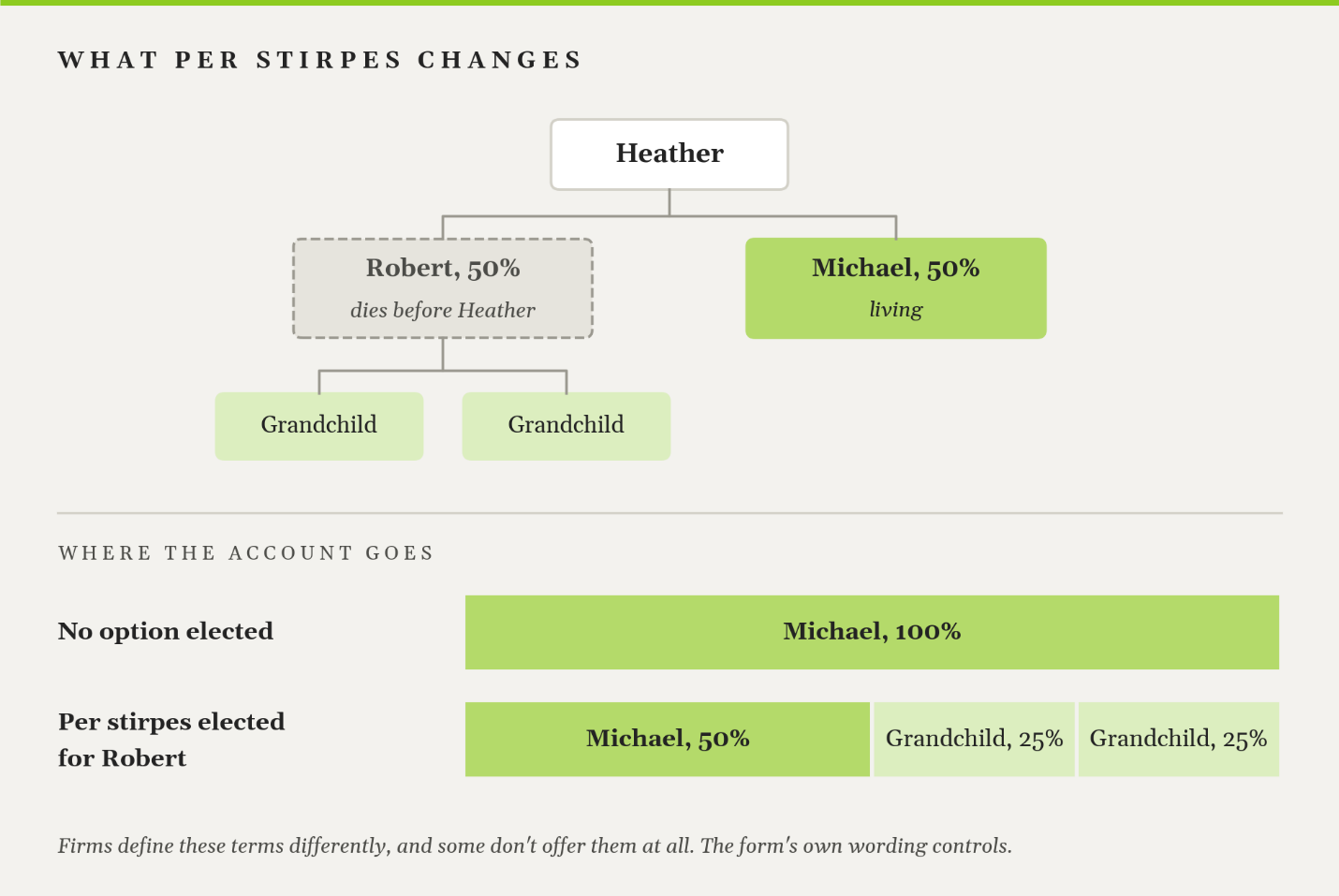
It might seem simpler to name Robert’s children as contingent beneficiaries. On most forms, that wouldn’t work. Contingent beneficiaries receive the account only if no primary beneficiary is left to receive it. As long as Michael is still living, he would receive Robert’s half in addition to his own.
These options are not guaranteed. A beneficiary form is part of the account agreement, and the law generally leaves it to each firm to decide which options its form offers and how to define them. Some firms don’t offer per stirpes at all, and some list it under another name, such as “LDPS,” short for lineal descendants per stirpes. A related option, per capita, divides an inheritance among people rather than branches, and its meaning can vary from one firm to the next. The firm generally follows the definition on its own form, which is why the wording on the form matters as much as the box that gets checked.
If a form doesn’t offer what a family wants, naming a trust as the beneficiary is one way around it, since the trust’s own terms then decide how the money is divided. A trust is a bigger step than a checkbox, though, and the next section looks at what it involves.
In the end, Heather elects per stirpes for both sons.
One checkbox decides whether Robert’s half stays in his branch of the family.
IV. When the Beneficiary Is a Trust or a Charity
Heather feels confident she has made the right choice for both of her sons. Robert, thinking of his own two children, raises a broader question: what happens when money is meant for someone too young to manage it? A minor generally cannot receive an inheritance directly. Some beneficiary forms let the owner name a custodian to manage a minor’s share, but only until the child reaches the age set by state law. At that point, the money is theirs outright. Without a custodian, a court may need to appoint a guardian. Heather’s form allows one, so she names a custodian in case Robert’s half ever passes to his children while they are young. A trust can hold the money longer, on terms the owner sets.
Naming a Trust as a Beneficiary
If a trust is named as the beneficiary, the account passes to the trust at the owner’s death, and the trustee manages the money according to the trust’s instructions. Naming a trust offers control: a trust can manage money for someone who shouldn’t receive a lump sum, or, in a second marriage, provide for a surviving spouse while making sure children from an earlier marriage still receive their share.
Heather would also like to leave part of the brokerage account to her grandchildren directly, and for that gift she wants more control than a custodian allows. Naming them one by one on the form would leave out any grandchild born later. A trust can be written to include every grandchild, including those not yet born. Michael wonders whether that much control is fair. Robert asks him to remember what they were both like at eighteen.
Heather decides the trust is worth it. She can name a trustee, someone she trusts to manage the money and follow her instructions, and she can decide when her grandchildren receive it: some for school, and the rest in stages once they’re older. She asks Michael, the one who questioned the idea, to serve as trustee. If anyone will be fair about it, she says, he will.
A trust also has costs. Because Heather’s trust will hold money for years, it will pay tax on the income it keeps rather than pays out, and that income reaches the top tax rate far sooner than an individual’s would: in 2026, a trust hits the top federal rate of 37% at $16,000 of taxable income, while a single filer doesn’t reach it until $640,600. Retirement accounts add another layer. A trust named on an IRA or 401(k) has to be written to meet IRS rules, or the people it benefits can lose the more flexible withdrawal options that individual heirs would have.
Naming a Charity or Donor-Advised Fund as a Beneficiary
The conversation also gives Heather a chance to raise something she has been meaning to mention: she would like part of the IRA she built while running her business to go to charity. A charity can be named on a beneficiary form the same way a person can, either for the whole account or for a percentage of it alongside family members.
Which account goes to charity can matter. When a family member inherits a traditional IRA, withdrawals are generally taxed as income. A qualified charity pays no income tax, so it keeps the full amount. A brokerage account generally works the other way: at the owner’s death, the holdings get a fresh starting value for tax purposes, so the gains built up over a lifetime aren’t taxed to the heirs. For someone who already plans to give, that can make the IRA the more efficient account to leave to charity. Whether it does depends on the family’s circumstances, which is why it’s a question worth raising with an accountant before the beneficiary form is filled out.
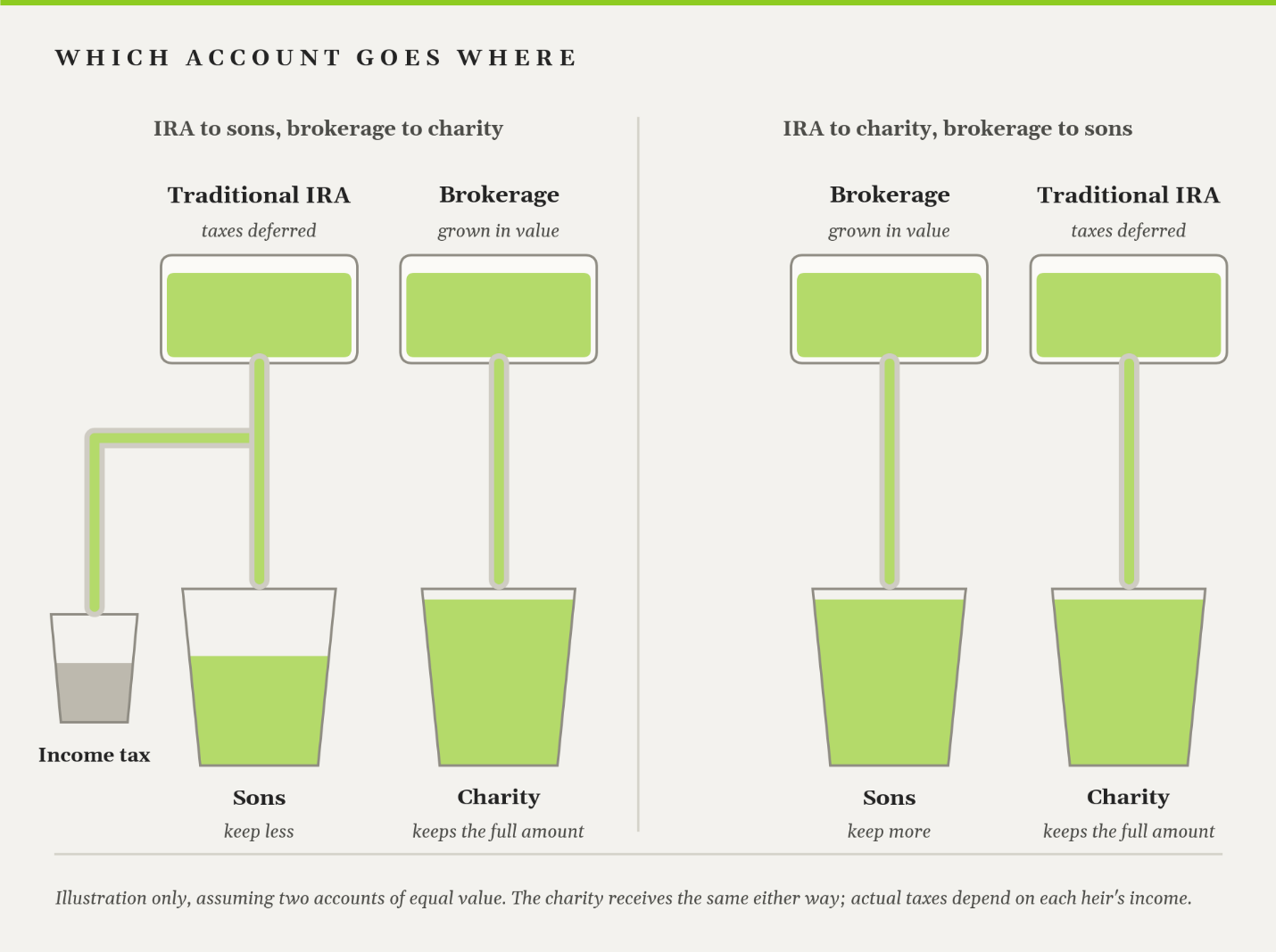
Rather than naming several charities, Heather can name a donor-advised fund, a charitable account that makes grants over time. After her death, the successors she chooses can keep recommending grants to the causes she cared about. Heather moves the charity’s share into a separate IRA, with the donor-advised fund as its beneficiary and Robert and Michael as the fund’s successors. A separate IRA also keeps the charity’s share from affecting the family’s: when a charity and family members share one IRA, the charity’s portion has to be paid out or split off soon after death, by deadlines the IRS sets, or the family can lose the option to spread their withdrawals over more years. For the first time all evening, the brothers agree on something.
Who receives an account matters. So does which account they receive.
Questions Worth Asking About Your Beneficiary Designations
These are the questions we work through with families when we look at how a plan fits together.
- Who is named on each account and policy, and is it still the person you would choose?
- Do the beneficiary forms and the will point in the same direction?
- Is there an account whose beneficiary no one can currently confirm?
- Have the beneficiary forms been reviewed since a marriage, divorce, death, or birth in the family?
- Is a contingent beneficiary named as a backup plan?
- If a beneficiary died first, should that share pass to their children, and does the form say so?
- Is anyone named who could receive money while still a minor?
- If a trust is named as a beneficiary, was it written with that account in mind?
- If charitable giving is part of the plan, has anyone considered which account best serves it?
If you would rather not do this alone
None of this requires a meeting. But if you would like a second set of eyes, bring your beneficiary forms, or a list of where they are held, to your next review. We will set them alongside your will and your accounts and make sure they tell the same story.
Where something needs your attorney or your accountant, we are used to working alongside them.
A note on this piece: This installment looks at the instructions attached to accounts through beneficiary forms, and why they often decide more than the will does. The purpose is not to suggest one arrangement is better than another, but to show why the form deserves a second look. The next installment turns to a decision this one touched only briefly: choosing a trustee. Naming a trust is often the easy part. Deciding who will run it, and for how long, deserves more thought.
Important disclosure: A.G. Campbell Advisory, LLC. The family wealth series, No. 03. Prepared for clients of the firm. AGCA works with families on the coordination this kind of planning requires, alongside their attorneys and accountants. Heather and her family are a hypothetical example. This material is for educational purposes only and is not investment, legal, or tax advice. Beneficiary rules, plan terms, tax treatment, and state laws vary by account, by institution, and by state. In some states a surviving spouse has rights that a beneficiary form does not override, and employer retirement plans generally require a spouse’s written consent to name anyone else.