First Quarter 2026 Commentary & Outlook
Dear Clients,
I hope this letter finds you well. Today, in Baltimore County the temperature is 82 degrees Fahrenheit on the fourth day of April. Though warm weather rarely perturbs me, you can imagine my surprise after stepping outside in a jacket and pants.
This, higher than average temperature, as an example, is a minor anomaly; a deviation from a historical average or forecast condition. These anomalies are nothing new to us in 2026. Some may recall the cold wave that hit North America earlier in the year, coming with blizzards, low single-digit temperatures, snow in Texas, and sub-35-degree temperature mornings in Florida. Those of you with family or friends in the southwest could be experiencing an unexpected heatwave with temperatures climbing as high as 100 degrees.
So, what’s the issue? Are meteorologists just wrong? Lousy equipment? The truth is simple. The instruments were fine, the science was sound, but the forecast is never the final word.
Modern weather forecasting is sophisticated. Meteorologists collect data from a global network of surface stations, weather balloons, radar systems, and satellites. The data is fed into powerful computational models involving supercomputers simulating the atmosphere. And yet, even with all the tools available, forecasters will tell you something important: model output is guidance, not final forecasts. The atmosphere is, at its core, a chaotic system.
Markets in Q1 followed a similar pattern. Entering the year, the prediction, entailing broad participation, healthy earnings, and a constructive economic backdrop seemed reasonable. The models agreed and the quarter began under clear skies. Then, within days of each other, three events arrived that no model had priced. On February 28, the U.S. and Israel launched strikes against Iran, closing the Strait of Hormuz and sending the price of oil above $100 a barrel. A Supreme Court ruling threw U.S. trade policy into fresh uncertainty. An AI-driven selloff erased hundreds of billions in market value for software-focused technology companies. Together, these three events changed the atmosphere entirely.
The S&P 500 finished Q1 in negative territory, down roughly 6.8% from its 52-week high, with five consecutive weeks of losses through March. Beneath the surface, the divergence was striking. Energy surged while technology struggled, international markets outpaced domestic large-caps, and value continued its rotation from growth reflective of investor caution.
This is precisely why we keep a proverbial umbrella in the trunk of our cars. Not because we always know when the next storm will hit, but because we want to be prepared and composed when the atmosphere has other plans.
Market Performance Summary
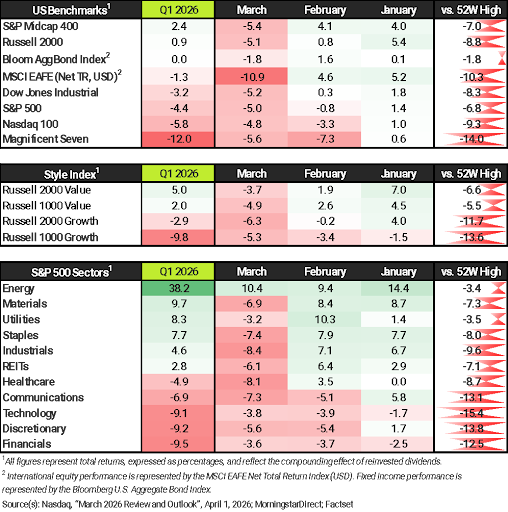
- S&P 500 declined 4.4% in Q1, finishing roughly 6.8% below its 52-week high. The Nasdaq 100 and Magnificent Seven were notable laggards, down 5.8% and 12.0% respectively, reflecting a meaningful rotation away from the concentrated mega-cap leadership that defined much of the prior two years.
- Small caps showed relative resilience. The Russell 2000 and S&P Midcap 400 both finished Q1 in positive territory, up 0.9% and 2.4% respectively, continuing the broadening trend that began late in 2025.
- Developed international markets underperformed on a quarterly basis, but the damage was concentrated in March. The MSCI EAFE finished Q1 down 1.3%, though it sits 10.3% below its 52-week high, reflecting outsized impact of the Iran conflict and rising oil prices on energy-dependent European and Asian economies.
- Energy was the standout sector by a wide margin. Up 38.2% in Q1, it was the only major sector to finish meaningfully positively, driven by oil’s surge above $100 per barrel following the Strait of Hormuz disruption.
- Value decisively outperformed growth. Russell 2000 value gained 5.0% while Russell 1000 Growth fell 9.8%, a spread of nearly 15 percentage points, underscoring how dramatically market leadership shifted during the quarter.
- Technology, Discretionary goods/services, and Financials were the hardest hit sectors, down 9.1%, 9.2%, and 9.5% respectively, each sitting more than 12% below their 52-week highs.
U.S. Economy: Q1 2026
The economy slowed meaningfully to close out 2025. The final revision to fourth quarter 2025 GDP (Gross Domestic Product) showed the economy growing at just 0.5% on an annualized basis, well below early estimates. Much of this downward revision was driven by slower consumer spending and sharp contraction in government spending tied to the shutdown. Looking ahead, the Atlanta Fed’s GDPNow model estimates Q1 2026 growth at approximately 1.3% as of April 9. The official advance estimate from the BEA (Bureau of Economic Analysis) is scheduled for April 30.
The labor market story is one of volatility. The economy shed 92,000 jobs in February, weighed heavily by the healthcare strike, followed by a rebound of 178,000 jobs in March, the most since December 2024, with gains concentrated in healthcare, construction, and transportation. Federal government employment continued to decline. Net job creation has been close to nil for more than a year, with the economy averaging just 22,000 jobs per month over the past twelve months.
On inflation, the Fed’s preferred gauge, the PCE (Personal Consumption Expenditure) price index, rose 2.8% year over year through February, with the core reading at 3.0%. Both remain above the Fed’s 2% target. The stickiest costs, housing, health care, and restaurant meals, have not meaningfully reversed in years. Getting inflation from 9% peaks down to 3% was the relatively straightforward part. Getting it from 3% down to 2% is proving far harder, because what is left is not the kind of inflation that responds to interest rate policy.
During its March meeting, the FOMC (Federal Open Market Committee) voted 11-1 to hold the federal funds rate steady at 3.50% to 3.75%, navigating higher-than-expected inflation, a softening labor market, and the economic uncertainty from the Iran conflict. The Fed also revised its inflation outlook upward, now projecting PCE at 2.7% for 2026, while GDP growth projections were nudged higher to 2.4%. Treasury yields rose meaningfully through the quarter, reflecting the surge in energy prices following the Iran conflict, persistent core inflation, and a market repricing of how many rate cuts to expect in 2026.
Beneath the market activity, two data points from the Federal Reserve’s Flow of Funds report deserve mention. First, American households added roughly $1.3 trillion to checkable deposit accounts in 2025, a level of cash accumulation not seen since the stimulus-driven surge of 2020. People felt the weather changing before the forecast said so. Second, Federal interest payments reached nearly $1 trillion last year against total federal tax receipts of roughly $5.3 trillion. For every dollar collected in taxes, roughly 19 cents went toward servicing existing debt. That ratio does not demand alarm, but it does demand attention.
The Bottom Line
The U.S. economy enters the second quarter of 2026 in a familiar posture: growth present but decelerating, inflation stubborn for reasons that sit largely outside the Fed’s reach, and a labor market that looks stable on the surface but reveals stress beneath it. The quarter’s defining events, a geopolitical shock, a shift in trade policy, and a fiscal backdrop quietly tightening, were not in any forecast at the start of the year. What they remind us, collectively, is that the atmosphere has a way of producing its own weather.
Looking Ahead: Q2 2026
Markets rallied sharply when the ceasefire between the U.S. and Iran was announced on April 8. We understand the instinct. After weeks of disruption, any signal of resolution feels like relief. But we would encourage a measured read of where things stand.
As of this writing, the Strait of Hormuz remains effectively closed. Before the conflict began, between 130 and 160 ships transited the strait daily. In the days following the ceasefire announcement, that number fell to single digits, with no oil or gas tankers among them. More than 600 vessels, including over 300 tankers, remain stranded in the Gulf. Iran has been charging tolls exceeding $1 million per ship for those seeking to pass, and its military has stated publicly that it considers control of the strait a legitimate right it does not intend to relinquish. Meanwhile, Israel and Hezbollah exchanged strikes on the first day of the truce, and peace talks in Islamabad are ongoing but unresolved as we write this. A ceasefire and a settlement are very different things.
We are not suggesting the situation will not improve. It may, and we hope it does. What we are saying is that the gap between a market rally and the physical reality on the ground is worth noting. Oil prices that fell sharply on ceasefire news have already begun climbing back as markets digest what is happening in the strait. The downstream effects on fuel costs, shipping rates, insurance premiums, and supply chains do not reverse overnight even when diplomacy succeeds, and diplomacy has not yet succeeded.
In moments like this, we find that patience is underrated. There will be opportunities that emerge from this period of uncertainty, and we are looking for them carefully. We have no interest in chasing a rally built on headlines that the facts have not yet caught up to. The businesses we own were chosen precisely because they do not require a perfect geopolitical outcome to perform well over time. That remains our standard, and we think it is the right one for the environment we are in.
In a quarter defined by uncertainty, conflict, and no shortage of noise, the steadiest thing in our work remains the relationships we have with you. We are grateful for the conversations, the questions, and the trust you extend to us each day. It does not go unnoticed, and it does not go unappreciated. We keep the umbrella in the trunk for you.
If someone in your life is navigating this environment without a clear plan or a trusted second opinion, please do not hesitate to connect with us. We are always grateful to meet people who matter to you, and we will treat that introduction with the same care you would expect for yourself.
Regards,
Alec Campbell | Vice President & Investment Advisor